
listicle
5 Questions to Ask a Gold Buyer Before You Sell
Editorial Team · · 10 min read
Last Updated: November 28, 2026
Quick Summary
Ask how the offer was calculated, whether the scale is calibrated and can be watched, whether you feel pressure to sell today, how purity is tested, and what experience and credentials the buyer has. A fair gold buyer will answer each question clearly and put the offer in writing.
- Ask the buyer to show the math, from spot price to karat to weight to margin.
- Confirm the exact spot price and timestamp used before running any calculations.
- Ask when the scales were last calibrated, and ask to see the record.
- Insist that purity testing happens in front of you, not in a back room.
- Get an itemized written breakdown and keep it, even for offers you decline.
Table of Contents
- Question 1: How Did You Arrive at This Offer?
- Question 2: Are Your Scales Calibrated, and Can I Watch the Weighing?
- Question 3: Is There Any Pressure to Sell Today?
- Question 4: How Is Gold Purity Tested, and Is Testing Done in Front of Me?
- Question 5: What Experience and Credentials Do You Have?
- How to Compare Gold Buyer Offers Side by Side
- Frequently Asked Questions
Question 1: How Did You Arrive at This Offer?
Ask for the math before you agree to anything. A fair buyer can explain exactly how a number was built, step by step, in plain language. If the answer is vague, treat that as information.
Most offers for gold jewelry start from the day's spot price for the metal, adjusted for the karat (the purity of the gold) and then reduced by whatever margin the buyer keeps. The weight of the piece matters too. Ask the buyer to show you each of those pieces on paper or on a screen.
The U.S. Commodity Futures Trading Commission advises consumers to ask how a dealer determines the value of precious metals and to get fees, costs, commissions, and the agreed price in writing before handing anything over (Customer Advisory: 10 Things to Ask Before Buying Physical Gold, Silver, or Other Metals). You can find that advice in its CFTC customer advisory on questions to ask before buying physical metals.
A worked example of a gold offer
Here is a simple way to check the math yourself. If you want to work out the per-gram figure on your own, how to calculate gold price per gram walks through it. You can follow the full step-by-step breakdown of how gold jewelry offers are calculated if you want every stage laid out. Say you have a 14-karat gold chain weighing 10 grams, and the spot price that day is $2,000 per troy ounce.
- Convert the spot price to a per-gram price. There are 31.1035 grams in a troy ounce, so $2,000 divided by 31.1035 is about $64.30 per gram.
- Multiply by the purity. 14-karat gold is 14/24, or about 58.3 percent pure. So $64.30 times 0.583 is about $37.49 per gram of actual gold.
- Multiply by the weight. 10 grams times $37.49 is about $374.90 in raw gold value.
- Subtract the buyer's margin. If the buyer pays 80 percent of melt value, the offer lands near $299.92. At 70 percent, it lands near $262.43.
That range is the part worth questioning. Ask the buyer what percentage of melt value they pay, and ask them to say it out loud. A buyer who quotes a number without naming that percentage is hiding the one figure that lets you compare them to anyone else.
Watch out: some buyers quote against a "spot price" that is actually a lower in-house number, so confirm the exact spot price and the timestamp they used before you run the math.
If the buyer's number is far below that result, ask them to walk you through the gap.
Question 2: Are Your Scales Calibrated, and Can I Watch the Weighing?
You should be able to watch your piece go onto the scale. Accurate weighing is the foundation of every offer, so ask how often the scales are calibrated and who checks them.
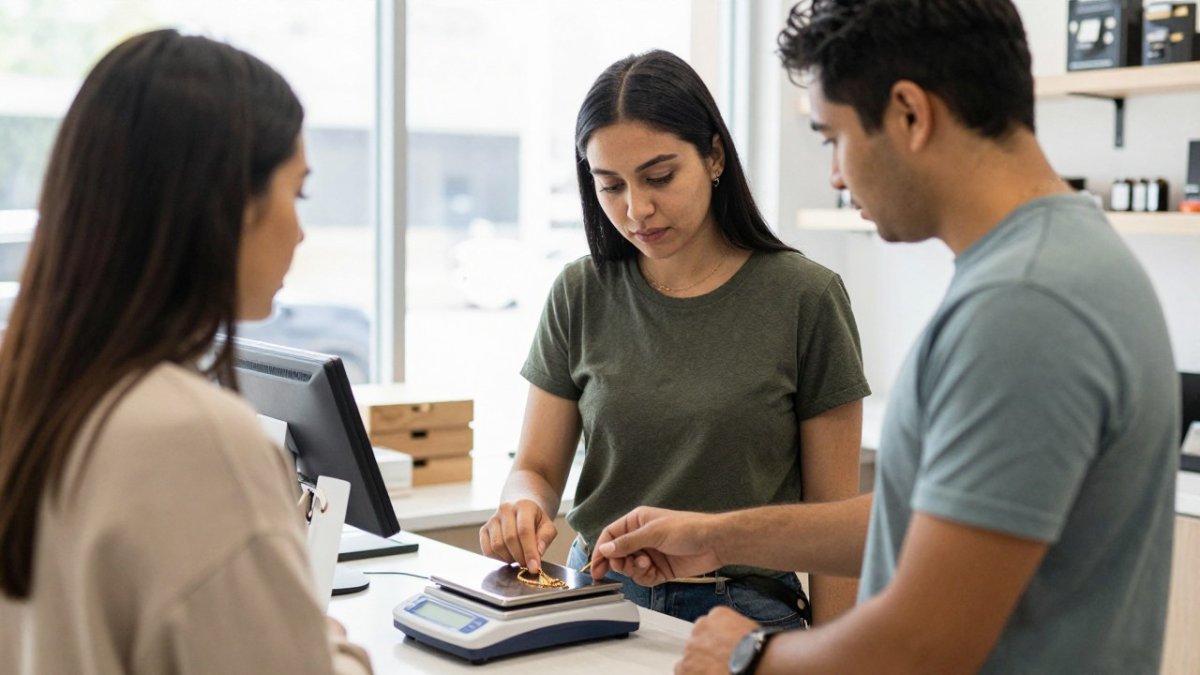
Calibration means the scale is compared against a certified reference weight and adjusted if it reads off. Ask when the last check was done, and ask to see the record if you want it. A reputable shop has no problem with that question.
!A seller and a buyer watching a small gold chain on a digital scale at a shop counter
Watch for a few warning signs. Be cautious if the buyer covers the scale with their hand, reads the weight aloud without showing you the display, or keeps your item out of sight.
Question 3: Is There Any Pressure to Sell Today?
A good buyer will let you walk away. If you feel rushed, that is a red flag.
Ask directly whether you can take a day or two to decide. Ask whether the offer stays open, and whether you can get it in writing. Many sellers feel pushed by a deadline that the buyer invented, so do not let urgency set your timeline.
Keep in mind that a fair offer will still be fair tomorrow. If the number disappears the moment you hesitate, you have learned something about the buyer.
Question 4: How Is Gold Purity Tested, and Is Testing Done in Front of Me?
Ask how the buyer confirms the karat of your gold. Common methods include acid testing, electronic testing, and checking hallmarks stamped on the piece, such as 14K or 585. Each method has limits, so ask which one they use and why.
Insist that testing happens in front of you. If a buyer takes your piece into a back room for testing and returns with a number, you have no way to confirm what happened. Watch for the phrase "we test everything in the back," which should prompt more questions.
If a result seems off, ask for a second test or take the item to another buyer for comparison. A legitimate buyer will not object.
Question 5: What Experience and Credentials Do You Have?
Experience is worth asking about. Ask how long the business has operated, what it is rated by, and whether it is a registered business in good standing.
At The Gold and Silver Exchange, we have 18 years in business and an A+ rating with the Better Business Bureau. Ask us any question about our credentials before you bring anything in.
Also ask about the written paperwork. You should receive an itemized accounting of every transaction, including the weight, purity, spot price used, and the final payment. Keep that record.
How to Compare Gold Buyer Offers Side by Side
Getting more than one offer is smart, but a headline number tells you little on its own. Check today's live gold and silver spot prices before you compare quotes. Compare the reasoning behind each offer, and write it down while you are standing there.
Use this worksheet when you line up two or three quotes. Copy it into a notes app or print it, and fill in one column per buyer.
| What to record | Buyer A | Buyer B | Buyer C |
|---|---|---|---|
| Date and time of quote | |||
| Spot price used (per troy ounce) | |||
| Karat and stated purity | |||
| Weight in grams, weighed in front of you | |||
| Testing method used | |||
| Payout percentage of melt value | |||
| Fees, commissions, or deductions | |||
| Net offer in dollars | |||
| Payment method and timing | |||
| Offer expiration date |
The point is to compare equivalent offers. If one buyer weighs in pennyweight and another in grams, convert before you compare. If one quotes a net number and another quotes a gross number with fees taken out later, ask both for the net.
Also ask each buyer for an itemized written breakdown before you leave. You want the weight, purity, spot price used, margin, and final payment on one page.
Watch out: a buyer who won't put the offer in writing, or who changes the number once you mention a competing quote, is telling you the first number was never firm.
Bring every item you plan to sell, along with any stamps, receipts, or documentation. A buyer can only quote what they can see.
For a stronger picture of the market, check the spot price before each visit and compare offers against it.
Looking for a local buyer you can question directly? Ask anything at The Gold and Silver Exchange, and we will walk you through the math before you decide.
Frequently Asked Questions
What questions should I ask when buying gold?
When you're buying gold, ask the seller how the price is set, what the fees and commissions are, and whether the agreed retail price will be put in writing before you hand over any money. Asking for every cost in writing is a good habit. It also helps to ask what you would receive if you sold the metal back the next day, which shows you how big the spread is. These questions apply to buying from a dealer, and they are just as useful when you are on the selling side and trying to understand what a buyer's number really means.
What percentage do gold buyers usually take?
There is no single standard percentage, because offers depend on the spot price of gold, the karat and weight of the piece, and the buyer's own pricing policy. Some buyers pay a percentage of melt value, and that percentage can vary a lot from one shop to the next. The most reliable way to find out is to ask the buyer what percentage of melt value they are offering on that day and to request the full calculation in writing. Once you have that, you can compare it directly with another offer.
Can I watch while a buyer tests and weighs my gold?
You should be able to, and you should ask before the appointment starts. Reputable buyers usually weigh and test items in front of the seller so both parties can see the result. If a buyer refuses to let you watch, or takes your items into a back room without explanation, treat that as a reason to walk away or get a second opinion. Watching the process lets you confirm the weight reading and the testing method yourself.
How can I avoid getting ripped off when selling gold?
Start by getting a written, itemized offer that shows the spot price used, the weight, the karat, and any deductions. Compare at least two offers from different buyers before you sell. Avoid pressure tactics, and don't feel you have to decide the same day. Keep copies of your receipt and the buyer's paperwork, and be cautious about sharing personal information beyond what the transaction requires.
