
how-to
How Gold Jewelry Offers Are Calculated, Step by Step
Editorial Team · · 6 min read
Last Updated: November 26, 2026
Quick Summary
Gold jewelry offers are calculated by weighing the piece, finding its pure gold content from the karat, and multiplying that pure weight by today's gold price. The buyer then pays a percentage of that raw value, which is why the offer is usually less than the full gold value.
- Weigh the piece in grams on a scale that reads to 0.01 grams.
- 14K gold is 58.3% pure gold, while 10K is 41.7% pure.
- Divide the spot price per troy ounce by 31.1035 to get the gram price.
- Only the pure gold portion counts toward the piece's value, not the whole weight.
- Ask any buyer to show the raw value and the payout percentage they applied.
Table of Contents
- How Are Gold Jewelry Offers Calculated?
- Gold Purity and Karat Chart: Finding the Pure Gold Content
- How to Calculate Gold Jewelry Value and Your Payout Percentage
- Frequently Asked Questions
How Are Gold Jewelry Offers Calculated?
Every gold jewelry offer is based on three things: how much pure gold is in the piece, how much that gold weighs, and today's gold price. Buyers generally multiply the pure gold weight by the spot price, then subtract their margin. The offer you get is rarely the full value of the gold, and that gap is worth understanding before you sell.
Here's the basic idea. Gold is priced per troy ounce on the live market, so a buyer converts your piece's weight and purity into that same unit. Then they apply a payout percentage to what the gold is worth. If you want to see how local buyers handle offers so you don't get lowballed, read how West Michigan buyers price gold jewelry. We walk through each step below so you can check the math yourself.
Gold Purity and Karat Chart: Finding the Pure Gold Content
Karat tells you how much of your piece is actual gold. 24K is pure gold (Rose Gold vs. Yellow Gold | Discover the Differences). 14K is 58.3% gold, and 10K is 41.7% (Guide to White, Yellow, and Rose Gold Engagement Rings). The rest is alloy, usually copper, silver or zinc, which gives the metal strength and color.
The stamp on your piece usually tells you the karat. Look for 10K, 14K, 18K or 24K, or a fineness number like 585 (14K) or 750 (18K) (Bench Tip #9: Use the Touchstone Method for Testing Purity in Karat Gold). If nothing is stamped, a buyer can test it, though an unmarked piece may get a lower offer until it is verified.
Only the pure gold portion counts toward the value. If you've worked out your pure gold weight, you can also look at selling gold by weight as bullion. A 10K chain weighing 10 grams contains about 4.17 grams of pure gold, not 10.
How to Calculate Gold Jewelry Value and Your Payout Percentage
Follow these steps to estimate what your piece should be worth:
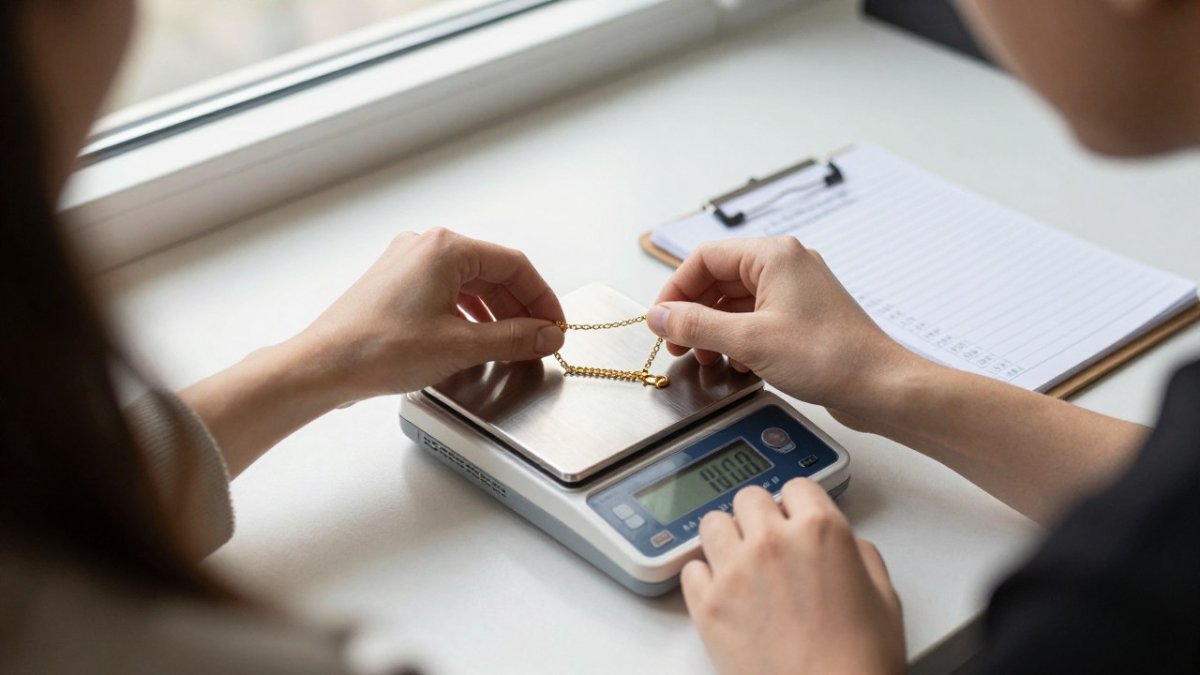
- Weigh the piece in grams. Use a scale that reads to 0.01 grams. Remove any stones first if you can.
- Find the karat purity. Convert it to a decimal. 14K is 0.583, 18K is 0.750.
- Multiply weight by purity. This gives you the pure gold weight.
- Get today's spot price per gram. Divide the spot price per troy ounce by 31.1035, since one troy ounce equals about 31.1 grams.
- Multiply pure gold weight by the gram price. This is the raw gold value.
- Apply the payout percentage. Buyers pay a share of the raw value, and that share varies by buyer.
For example, a 14K ring weighing 8 grams has about 4.66 grams of pure gold. Multiply that by the current gram price to get the raw gold value, then apply the buyer's payout percentage.
Your payout percentage depends on the buyer's costs, resale plans and the type of piece. If you still need to turn a gram weight into a price per gram, this walkthrough shows the math. Ask any buyer to show you the raw value and the percentage they applied. A buyer who won't show that work is worth questioning.
To get an offer, visit the exchange or send a message and the team will weigh and test your piece in front of you. For a quick check on the spot price, see current gold and silver prices before you come in.
The steps below cover the calculation from weighing your piece to applying a buyer's payout percentage.
| Step | What to do | Note |
|---|---|---|
| Weigh the piece | Use a scale that reads to 0.01 grams | Remove stones first if you can |
| Find karat purity | Convert to a decimal | 14K is 0.583, 18K is 0.750 |
| Multiply weight by purity | Get the pure gold weight | Gives the actual gold content |
| Get spot price per gram | Divide troy ounce price by 31.1035 | One troy ounce is about 31.1 grams |
| Calculate raw gold value | Multiply pure gold weight by gram price | This is the full gold value |
| Apply payout percentage | Buyer pays a share of raw value | Share varies by buyer |
Frequently Asked Questions
Why can two gold buyers offer different amounts for the same jewelry?
Buyers set their own payout percentages and check purity by different methods, so the same piece can get different offers. Some buyers use a higher percentage of the spot price, while others deduct more for testing, handling or resale costs. Ask each buyer to show the weight, karat, spot price and payout percentage they used, then compare those numbers directly. A buyer who explains the math in writing is easier to trust than one who gives only a final number.
Does the weight of gemstones affect a gold jewelry offer?
Usually not. Gold buyers generally weigh the gold itself and deduct the weight of stones or other non-gold parts when they can separate them. Diamonds, pearls and most gemstones are valued separately, if at all, and they are not counted as gold. Remove large stones before you sell if you want an accurate gold-only offer, and ask the buyer whether stone weight was subtracted from the total.
How do you calculate the value of gold jewelry before selling it?
Start with the weight in grams, which you can read from a calibrated scale or from a stamped or listed weight. Multiply that weight by the karat's pure-gold fraction: 14K is about 58.3 percent gold, and 10K is about 41.7 percent. Then multiply the pure gold weight by the current spot price per gram. Finally, apply the buyer's payout percentage. The result is a realistic estimate of the cash offer you can expect.
