
how-to
How to Calculate Gold Price per Gram
Editorial Team · · 11 min read
Last Updated: November 7, 2026
Quick Summary
To calculate gold price per gram, divide the live spot price per troy ounce by 31.1034768, then multiply your item's weight in grams by its karat purity factor (karat ÷ 24) and by that per-gram price. For example, a 10-gram 14K chain at $130.91 per gram has a melt value of about $763.
- One troy ounce equals 31.1034768 grams, so always convert before pricing.
- Divide the karat number by 24 to get the purity factor, such as 14K at 0.583.
- The full formula is weight in grams × purity factor × spot price per gram.
- A standard ounce is about 2.75 grams lighter than a troy ounce, causing roughly 9% overstatements.
- Sort scrap by karat and remove stones, clasps, and non-gold parts before weighing.
Table of Contents
- The Four-Step Formula for Gold Price per Gram
- Worked Example: From Live Spot Price to a Specific Item Value
- Using a Gold Calculator in oz, Grams, or Kilograms
- The Price of 14K Gold per Gram and Other Common Karats
- How a Gold Price Calculator Handles 22K and 18K Alloys
- Running a Gold Scrap Calculator on Broken and Mixed Jewelry
- Melt Value, Spot Value, Retail Price, and a Buyer's Offer
- Get Your Gold Weighed and Priced in Front of You
- Frequently Asked Questions
The Four-Step Formula for Gold Price per Gram
Gold was listed at $130.91 per gram on November 7, 2026, based on a spot price of $4,071.67 per troy ounce, according to GoldPrice.com's gold price per gram page. That single number is where every honest valuation starts.
The formula has four moving parts: spot price, weight, purity, and multiplication. Miss one and your estimate drifts. Here is how each step works.
Step 1: Find the Spot Price and Convert Troy Ounces to Grams
Gold trades in troy ounces, not the ounces on your kitchen scale. One troy ounce equals 31.1034768 grams, and that conversion is the first place people go wrong. Look up the live spot price per troy ounce, then divide by 31.1034768 to get the price per gram. Our current gold and silver prices page shows live spot pricing per troy ounce during market hours.
Step 2: Weigh Your Item Accurately
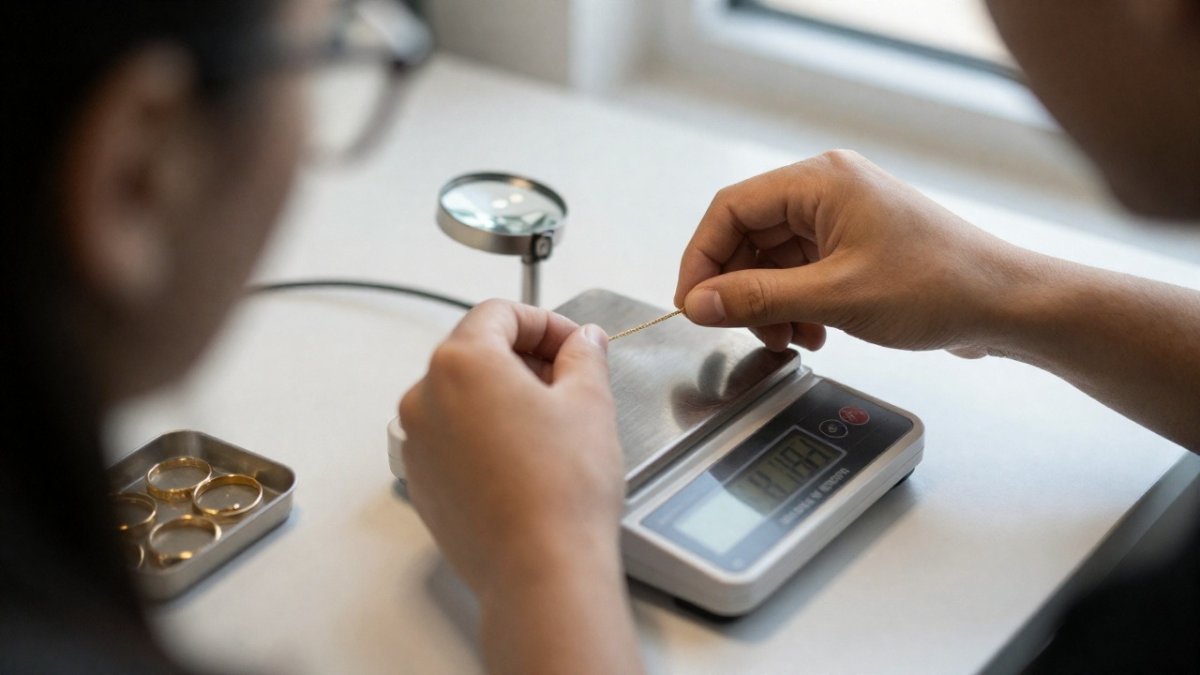
A postal scale reading in regular ounces will mislead you. Use a digital scale that reads in grams and calibrate it before weighing. Weigh chains, rings, and scrap separately so you can track each piece. A common mistake is weighing jewelry with stones still set, which inflates the total weight with material that is not gold.
Step 3: Apply the Karat Purity Factor
Karat tells you what share of the item is actual gold. Divide the karat number by 24 to get the purity factor. A 14K piece is 14 divided by 24, or roughly 58.3% gold. A 22K piece is about 91.7%. Stamp markings help, but worn or foreign jewelry often lacks a readable mark, which is why testing matters.
Step 4: Multiply Weight by Purity by Price per Gram
Here is the whole formula in one line: weight in grams × purity factor × spot price per gram = melt value. That figure is the raw gold content, not what a buyer will pay.
Worked Example: From Live Spot Price to a Specific Item Value
Take a 14K gold chain weighing 10 grams, using the November 7, 2026 spot price of $130.91 per gram. First, the purity factor: 14 ÷ 24 = 0.583. Then multiply: 10 grams × 0.583 × $130.91 = about $763 in melt value. That is the gold content alone.
Now compare it to the same day's listed 14K price. GoldPrice.com listed 14K gold at $76.58 per gram on that date, and 10 grams at that rate lands near $766, close enough to confirm the math. If you want to see what pushes the spot price up or down between visits, our market outlook covers the forces behind it.
Using a Gold Calculator in oz, Grams, or Kilograms
A gold calculator oz input is handy for bullion, but most jewelry is weighed in grams and larger holdings in kilograms. The math does not change, only the unit. Convert everything to grams first, then run the formula.
| Unit | Grams | Best For |
|---|---|---|
| Troy ounce | 31.1034768 | Bullion bars and coins |
| Standard (avoirdupois) ounce | 28.3495231 | Postal scales, kitchen scales, not gold |
| Gram | 1 | Jewelry and scrap |
| Pennyweight (dwt) | 1.55517384 | Older jewelry tags and some dealer scales |
| Kilogram | 1,000 | Large holdings |
Grams
A gold price calculator that lets you switch units saves you from conversion errors.
Here is the same 10-gram, 14K chain from the worked example, expressed three ways at the November 7, 2026 spot price of $130.91 per gram:
- In grams: 10 g × 0.583 × $130.91 = about $763 in melt value.
- In troy ounces: 10 ÷ 31.1034768 = 0.3215 troy oz. At $4,071.67 per troy ounce, 0.3215 × $4,071.67 × 0.583 = about $763. Same answer, different input.
- In kilograms: 0.010 kg × 1,000 = 10 g, then run the gram formula. A 1 kg bar of .999 fine gold at that spot price would be 1,000 × 0.999 × $130.91 = about $130,779 in melt value.
Watch out: many online calculators default to troy ounces but label the field simply "oz." If you type a postal-scale reading into a troy-ounce field, your estimate comes out roughly 9% high.
Pennyweight is the quiet trap in estate jewelry. Some older tags and dealer scales read in dwt, and 1 dwt equals 1.555 grams, so a chain tagged "8 dwt" is about 12.4 grams, not 8.
The Price of 14K Gold per Gram and Other Common Karats
The price of 14K gold per gram is the spot price per gram multiplied by 0.583. On November 7, 2026, that worked out to $76.58 per gram, per GoldPrice.com's karat listings. Higher karats cost more per gram because they hold more gold.
Here is how the common karats compare at that same spot price:
| Karat | Purity | Approx. Price per Gram |
|---|---|---|
| 10K | 41.7% | $54.59 |
| 14K | 58.3% | $76.32 |
| 18K | 75.0% | $98.18 |
| 22K | 91.7% | $120.04 |
| 24K | 99.9% | $130.78 |
A 2026 gold-price guide from Goldzenn listed similar per-gram figures by karat, which confirms the pattern. Notice how fast the value drops as purity falls.
Either the formula or a published karat listing is close enough for an estimate; neither is a quote.
Where the table stops being useful. A per-karat price assumes the whole item is that karat. Real jewelry rarely is. Three patterns account for most of the overestimates people get from karat tables:
- Mixed-karat pieces. A 14K chain with an 18K clasp, or a ring with a 10K shank and a 14K head, is not one purity. Weigh and price each component at its own karat, or use the lowest karat for the whole piece if you cannot separate them. Using the highest karat on the whole weight is the single most common way a self-estimate comes out too high.
- Stones and non-gold settings. Diamonds, colored stones, and the metal settings that hold them are not gold. A 5-gram ring with a 1-gram stone is a 4-gram gold item. Remove stones you can, and ask the buyer to weigh the item before and after stone removal so the difference is on the record.
- Clasps, springs, and repairs. Lobster clasps, spring rings, and soldered repairs are frequently base metal or a lower karat. On lightweight chains the clasp can be 10% or more of total weight. A buyer with a calibrated scale will separate these anyway; sorting them yourself keeps the estimate honest.
Reading the stamp, and its limits. A "14K" or "585" stamp is a starting point, not proof. Stamps wear, get applied incorrectly, and are sometimes counterfeited. A common pattern is for imported pieces to carry a mark that does not match the metal.
A quick reconciliation check. If your karat-table estimate and your formula estimate disagree by more than a few percent, the cause is almost always one of three things: a unit error (troy versus standard ounces), a mixed-karat item priced at a single karat, or non-gold weight left in the total. Recheck those three before you assume the market moved.
How a Gold Price Calculator Handles 22K and 18K Alloys
A gold price calculator 22K or 18K input simply changes the purity factor, but alloys add a wrinkle. 22K jewelry is common in South Asian and Middle Eastern pieces, where buyers expect high gold content. 18K is standard for fine jewelry because the added metals make it durable enough for daily wear.
Those added metals are not gold, and they are not worth gold prices. A calculator that ignores this will overstate your item's value. What most guides miss is that two 18K rings of identical weight can differ in real value if one has a heavy clasp or a soldered repair in base metal.
Running a Gold Scrap Calculator on Broken and Mixed Jewelry
Broken chains, single earrings, and mismatched pieces are exactly what a gold scrap calculator is built for. Sort your scrap by karat first, then weigh each pile separately. Mixing karats in one pile forces you to use the lowest purity, which costs you money.
Watch out: clasps, springs, and stone settings are often not gold, or are a lower karat than the piece itself. Remove what you can and note what you cannot.
Melt Value, Spot Value, Retail Price, and a Buyer's Offer
These four numbers are not the same, and confusing them is the fastest way to feel cheated. Melt value is the raw gold content from your formula. Spot value tracks the market price at a given moment. Retail price adds design, brand, and craftsmanship, which is why finished jewelry sells for more than its gold weight.
A buyer's offer sits below melt value, because refining, testing, and margin all cost money. That gap is normal. What matters is that the offer is explained to you line by line. Our bullion by weight and fine jewelry pages show how we handle both sides of that difference.
Get Your Gold Weighed and Priced in Front of You
The formula gives you a solid estimate, but accurate valuation needs a calibrated scale and a real purity test. We have 18 years in business and offer no-pressure assessments with no obligation to sell. Every transaction comes with a full written accounting, and we offer same-day settlement in cash or check.
Bring your jewelry, coins, or scrap to visit us or send a message, and we will walk you through the math on your own items before you decide anything.
The gap between a rough estimate and a fair offer comes down to accurate weighing and honest testing. The Gold and Silver Exchange provides valuation in front of you on calibrated scales, a written accounting of every transaction, and same-day settlement, backed by an A+ BBB rating and 18 years in business.
Frequently Asked Questions
How do you calculate the price of gold per gram?
Divide the spot price per troy ounce by 31.1034768 to get the price per gram, then multiply by the item's weight in grams and its purity factor. A 14K piece holds 58.3% gold, so its gold content is worth 58.3% of the pure gold price per gram at the spot price you look up.
Does a gold calculator show the amount a buyer will pay?
No. A calculator shows melt value, which is the metal content at the live spot price. A buyer's offer sits below that to cover refining, assay, and operating costs, so expect a gap between the two numbers. Ask the buyer to show you the spot price they used, the weight on their calibrated scale, and the purity they assigned, then compare that against your own gold price per gram calculation before you agree.
How much is 18K or 22K gold worth per gram?
Multiply the pure gold price per gram by the karat's purity. With gold at $130.91 per gram, 22K (91.7% pure) comes to about $120.04 per gram and 18K (75% pure) to about $98.18. A gold price calculator 22K users rely on does the same multiplication.
Why is my gold jewelry worth less than the calculator says?
Stones, clasps, and non-gold components add weight that is not gold, so a gold scrap calculator should only count the metal. Purity markings can also be wrong or missing, and a buyer may test with acid or X-ray before pricing. Weigh the item, subtract obvious non-gold parts, and confirm the karat stamp. Then compare your figure to the buyer's written breakdown, which a transparent dealer will provide before you commit.
