
blog
Are Gold Buyers Near Me Trustworthy?
Editorial Team · · 9 min read
Last Updated: November 10, 2026
Quick Summary
To find reputable gold buyers, confirm the business's legal name and address, check licensing and complaint records, and insist on watching the weighing and testing in person. Compare at least two written offers using the same weight, purity and spot price before you accept any payout.
- Get the legal business name, a physical street address and a direct phone number before selling.
- Check the Better Business Bureau profile and your state attorney general's complaint database.
- Watch the buyer weigh and test your items, and ask them to explain the method.
- Calculate melt value by multiplying pure gold weight in troy ounces by spot price.
- Get at least two written offers and never accept a first offer under time pressure.
Table of Contents
- Why Finding Reputable Gold Buyers Nearby Matters
- How to Verify a Gold Buyer's Reputation
- What Percentage Do Gold Buyers Pay?
- How to Compare Gold Buyer Offers Side by Side
- How to Sell Gold Without Getting Ripped Off
- Booking Your Appraisal at The Gold and Silver Exchange
- Frequently Asked Questions
Why Finding Reputable Gold Buyers Nearby Matters
Finding reputable gold buyers nearby matters because the offer you accept depends heavily on who you sell to. Gold buyers in the United States can pay very different amounts for the same items, and the difference often comes down to how transparent the buyer is about weight, purity and melt value. Reading a few Jewelry by Designs guide to scrap gold buyers, which reports payouts of 70% to 95% of melt value is a good start, but the real test is what happens across the counter.
Gold's market value is also moving. In the third quarter of 2026, World Gold Council's gold demand trends report found total demand fell 1% year over year to 1,369 metric tons, while the value of that demand rose 22% to US$188 billion. Prices matter, and a buyer who quotes you a number without showing the math is asking you to trust them blindly.
This guide from The Gold and Silver Exchange explains how to vet a buyer, read an offer and sell without losing money you did not need to lose. Learn more about who we are and why West Michigan sellers trust us. What our customers say if you want to see how other sellers describe their experience before you decide.
How to Verify a Gold Buyer's Reputation
A buyer's reputation is easier to test than most sellers assume. Work through the checks below before you bring anything valuable through the door, and write down what you find so you can compare buyers on equal terms.
Step 1: Confirm the business identity. Get the legal business name, the physical street address and a direct phone number. Search the legal name, not just the storefront name, in your state's business entity registry. A legitimate operation can be matched to a registered entity. A shop that will only give a first name, a post office box or a mobile number deserves a reason to walk away.
Step 2: Check licensing where it applies. Requirements for secondhand precious-metal dealers are set at the state and sometimes the city level. Ask the buyer which license or registration applies to their location and ask to see the document. If the answer is vague, treat that as information.
Step 3: Review complaint history. Check the Better Business Bureau profile for complaint volume, how complaints were resolved and whether the business responded. Also search your state attorney general's consumer complaint database. A few resolved complaints across several years is normal for an active business. Unanswered complaints or a cluster of recent ones is a pattern to investigate.
Step 4: Read reviews for specifics. Useful reviews name the item sold, the weight quoted, the payout and how the payment arrived. Reviews that repeat the same phrasing, appear in a short burst or praise only generic friendliness deserve less weight. Read the negative reviews as carefully as the positive ones. Complaints about hidden deductions, scale disputes or pressure to sell are more serious than complaints about a single disappointing price.
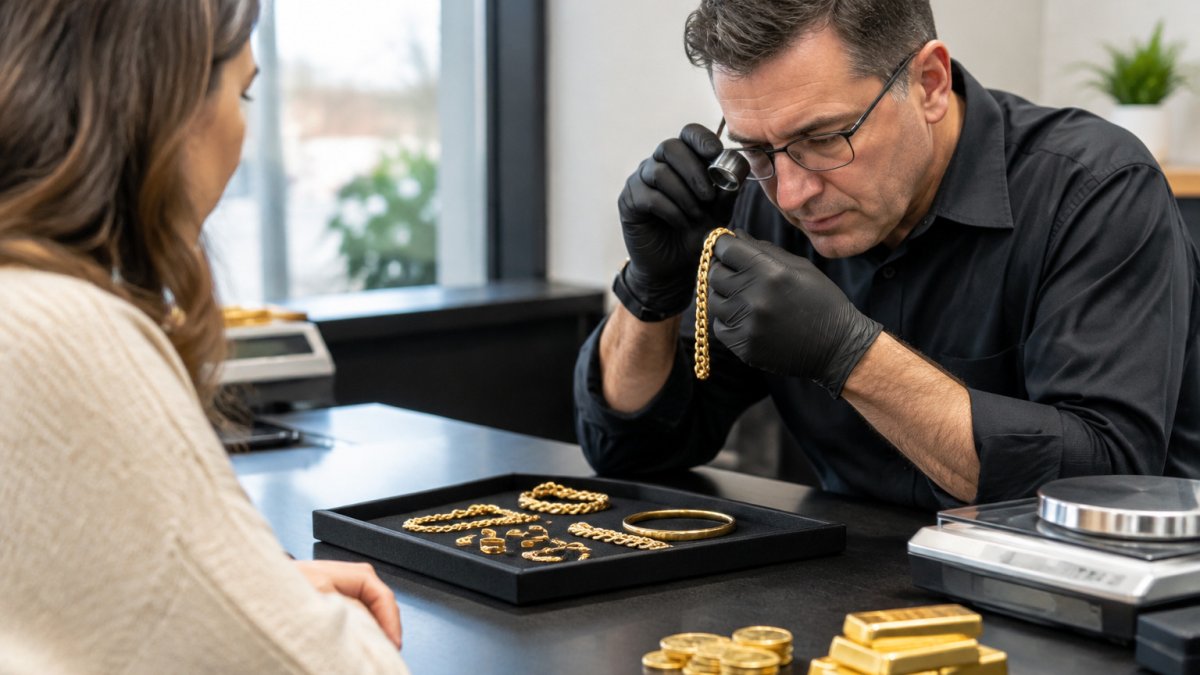
Step 5: Test transparency in person. Ask the buyer to weigh and test your items in front of you, to explain the testing method and to show the scale reading. A reputable buyer expects these questions and answers them without irritation. Watch out: a shop that will not let you watch the weighing or testing is withholding the one step you cannot verify later.
Step 6: Record what you found. Keep a short written note of the business name, registration details, complaint results, and how the buyer responded to your questions. Comparing these notes across two or three buyers usually makes the strongest choice obvious.
No single check settles the question. A business that passes licensing, shows a clean complaint record and welcomes scrutiny at the counter is a far safer bet than one that excels at only one of those things.
What Percentage Do Gold Buyers Pay?
Payout percentages are a shorthand that hides the real arithmetic. A buyer might quote 80% of melt value and still pay less than a competitor quoting 75%, depending on how each one defines melt value and what they deduct. Knowing the steps lets you check any offer yourself.
Step 1: Establish purity. Gold jewelry is stamped with karat marks such as 10K, 14K, 18K or 24K, which indicate the fraction of pure gold by weight. 24K is 100% pure, 18K is 75%, 14K is about 58.3% and 10K is about 41.7%. Stamps are not always present or accurate, so ask how the buyer confirmed purity and whether a test was run.
Step 2: Weigh the pure gold content. Multiply the item's total weight by its purity fraction. A 10-gram 14K chain contains about 5.83 grams of pure gold. Weigh in grams or troy ounces on a calibrated scale, and ask whether the weight is the gross weight including stones and clasps or the net weight of metal alone.
Step 3: Find the spot price. Gold is priced per troy ounce, and one troy ounce equals about 31.1035 grams. Use the published spot price for the day of the sale as your reference. Most buyers quote a percentage of this figure, so the spot price you check should match the one the buyer uses.
Step 4: Calculate melt value. Melt value equals pure gold weight in troy ounces multiplied by spot price per troy ounce. Using the example above, 5.83 grams is about 0.187 troy ounces, which at a hypothetical spot price of US$2,000 per ounce gives a melt value of about US$374.
Step 5: Apply the payout percentage. Multiply melt value by the buyer's stated percentage. At 80%, that example would pay about US$299. Ask whether the percentage applies to melt value or to some other base, and whether any refining, testing or handling fees come off the top.
Step 6: Compare on equal terms. Two offers can only be compared when they share the same weight basis, purity, spot price and deduction policy. If one buyer uses a higher percentage but a lower purity or a different spot price, the offers are not comparable until those inputs are aligned.
If a quote falls well below this calculation, ask the buyer to walk through each step aloud. A reputable buyer can explain every input, and an unexplained gap is the clearest sign that a deduction is being made without your knowledge.
Each payout is worked out from a few inputs, so you can check any offer yourself using these figures.
| Karat | Pure gold content | Note |
|---|---|---|
| 24K | 100% | Fully pure gold |
| 18K | 75% | Three-quarters gold |
| 14K | About 58.3% | Common in jewelry |
| 10K | About 41.7% | Lowest common purity |
Scrap gold payout as share of melt value
How to Compare Gold Buyer Offers Side by Side
Get at least two written offers for the same items. Compare the weight, the stated karat or purity, the spot price used and the final payout. A higher offer can still be a worse deal if the buyer used a lower purity than your item actually carries.
Ask each buyer how they determine purity. Testing methods should be explained, not hidden behind a single number.
How to Sell Gold Without Getting Ripped Off
Bring your items to the shop unpolished and unrepaired. Keep receipts or appraisal paperwork if you have them, since they can support the stated weight and purity.

Never sell on the first offer if you have time to compare. A reputable buyer will not pressure you to decide on the spot. A buyer who says the offer expires in an hour is using a high-pressure tactic.
Ask for written documentation of every transaction. The Gold and Silver Exchange provides a full written accounting of each transaction, which lets you check the figures later.
Booking Your Appraisal at The Gold and Silver Exchange
The Gold and Silver Exchange offers no-pressure assessments with no obligation to sell. Valuations happen in front of you on calibrated scales, and settlement is available the same day in cash or check. Walk-ins are welcome, and private appointments are available.
Visit Us or Send a Message to get the location details, phone number and booking information. Bring your items, ask every question on this list, and compare the written figure before you decide.
Frequently Asked Questions
Who gives you the most money for your gold?
No single buyer is always highest, because offers depend on the day's spot price, the item's purity and weight, and the buyer's margin. Get written quotes from two or three reputable buyers and compare them against the same spot price. The Gold and Silver Exchange prices against the live spot market and provides every calculation in writing, so you can check the numbers yourself before deciding.
What percentage do gold buyers usually pay?
Payouts vary by item type and buyer. Payouts vary by item type and buyer, and no offer is guaranteed in advance. Ask any buyer how they determine weight, purity and melt value, and whether their offer is based on the live spot price.
How can I tell if a gold buyer is reputable?
Check the buyer's business history, third-party ratings such as Better Business Bureau standing, and whether they weigh items in front of you on calibrated scales. A reputable buyer makes no-pressure assessments, gives you no obligation to sell, and documents each transaction in writing. Be cautious of pop-up events, high-pressure tactics, or offers you cannot review before agreeing.
